There’s another AI I wish more leaders were talking about: Appreciative Inquiry
It starts with a question you can ask your team tomorrow.
Tell me about a time we were at our best. What made that possible?
If you’re in the middle of scaling a company, that question might feel like a luxury. A handoff keeps breaking. A department is missing its goals. Decisions you thought you’d delegated keep landing back on your desk. Of course you want to know what’s going wrong.
But if that’s the only question you ask, you can miss something your company already knows how to do.
“We live in a world created by our questions.” – Dr. David Cooperrider
An organization is a living system
Appreciative Inquiry grew out of David Cooperrider’s research at the Cleveland Clinic while he was a doctoral student at Case Western Reserve University. Cooperrider and his mentor Suresh Srivastva asked what they could learn by studying moments when an organization was at its best. What did people do differently? What conditions made that possible? What could the organization become if those conditions were more common? Cooperrider and Srivastva, Appreciative Inquiry in Organizational Life
I think of Appreciative Inquiry as a strengths-based operating system for a living organization. People interpret what happens around them. They watch what leaders pay attention to. They figure out how to get good work done, sometimes in ways that never show up on an org chart.
That matters in the grow-up phase. As the company gets bigger, the founder has less firsthand knowledge of what happens between teams and in the moments that matter to customers. The people doing the work can tell you where the company is already getting it right and what it takes to do it more often.
Five principles help explain why this kind of inquiry can change a team.
- Constructionist. The stories people tell about the company shape what they expect from each other and how they act.
- Simultaneity. Change starts with the first question. What you ask signals what matters and whose experience counts.
- Poetic. Every organization has more stories than the ones it tells most often. Ask a different question and you may hear a part of the story you’ve been missing.
- Anticipatory. A vivid picture of a future worth building can change the decisions people make today.
- Positive. Hope and connection help people stay engaged in the work of change, especially when they can point to something they’ve already done together.
Cooperrider and Whitney, Appreciative Inquiry: A Positive Revolution in Change
What this looked like in a 150-year-old organization
An organization that had been around for more than 150 years hired me to help build a new roadmap. In those first conversations, I heard things like, “Our board is just useless.” Departments barely knew what their counterparts were working on, and one important division was missing its goals.
We started with Discovery, the first phase of Appreciative Inquiry’s 4-D cycle. We asked people to tell us about specific moments when the organization had lived up to its mission. What happened? Who made it possible? What was in place that allowed them to do that work?
You know what we found? People were making extraordinary sacrifices for the people they served. There was a depth of care and commitment that had barely come up in those first conversations. Appreciative Inquiry calls the strengths and conditions that made those moments possible the positive core.
In the Dream phase, we asked, “What would it look like if our board was a catalytic force for our mission?” We developed eight statements about what the organization could become and brought more than 80 people from across the organization together to work on them.
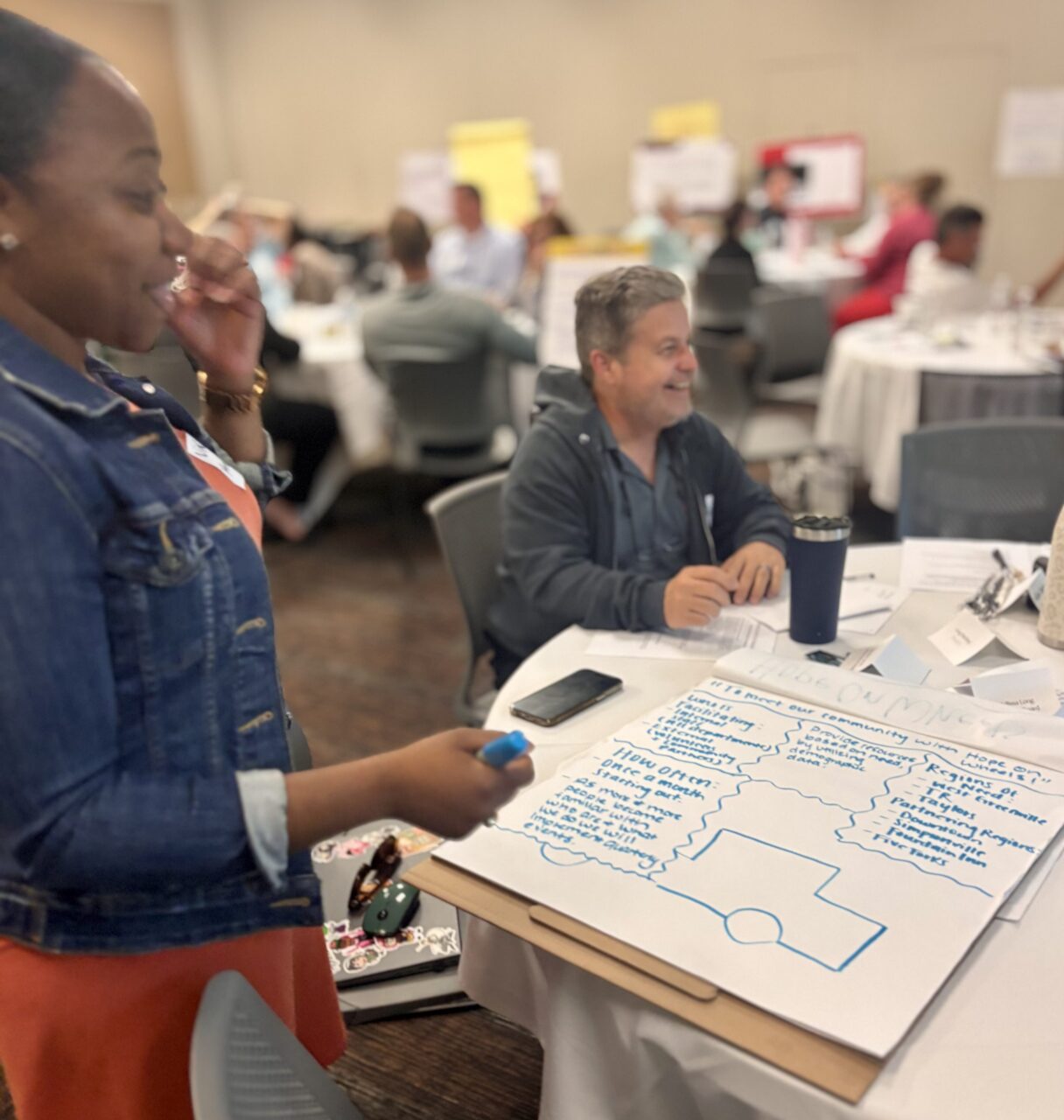
Then came Design. Small groups turned those aspirations into prototypes. I remember tears in those sessions. People who had spent a lot of time talking about what was stuck were now drawing up things they wanted to try together.
The last phase, Destiny, is where people put those ideas to work and learn from what happens. The team built a simple roadmap and got to work on it. In less than a year, the struggling division was hitting its goals again. I also saw people across departments begin to share more of the work.
“The task of leadership is to create an alignment of strengths in ways that make a system’s weaknesses irrelevant.” – Peter Drucker
A question to take into your next meeting
Pick something your company needs to get better at. If customer handoffs keep breaking, for example, ask the people closest to the work to tell you about one handoff that went exceptionally well. Listen for the details. Who knew what, and when? Who had the authority to make a call? What did the customer experience?
Sometimes you’ll discover that a great outcome depended on someone quietly working late and saving the day. Thank that person. Then ask what would need to change so the next customer gets the same care on an ordinary Tuesday.
That’s where I’d start. Find one thing your people already know how to do beautifully. Understand what made it possible. Then build a company where it can happen more often.
–Chris Cloud / Master Facilitator and Appreciative Inquiry Practitioner

